


Lower current does not mean you can just swap the pack
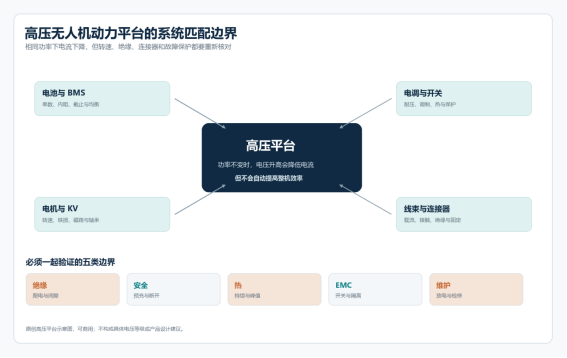
Raising voltage lowers current for the same power, but RPM, KV, insulation, connectors, ESC and safety strategy all have to be redesigned together.
Where the benefit of high voltage actually comes from
For a given power, higher voltage means lower current, so conductor heating and harness voltage drop fall. That is one reason heavy-lift UAVs look at higher-voltage platforms. But the power relationship describes an ideal trend; real systems also carry ESC efficiency, motor loss, pack internal resistance and connector contact resistance.
Raise voltage and no-load RPM rises too. Keep the old KV and prop and the operating point may move to higher RPM, increasing core loss, drag and bearing load. Holding a sensible RPM usually means re-selecting KV, gear ratio or prop, and re-checking ESC modulation and control bandwidth.
The advantage depends on the whole chain. Weight saved by thinner harness can be cancelled by more complex connectors, insulation and protection; loss saved by lower current can be cancelled by higher electromagnetic loss at speed. Only a combined calculation of weight, efficiency, heat and reliability shows whether higher voltage suits the mission.
Insulation and safety boundaries must be upgraded together
Higher DC voltage tightens requirements on creepage, clearance, insulation material, potting and harness fixation. Humidity, condensation, dust and altitude change insulation behaviour, and contamination after connector mating can create leakage paths. Phase leads, busbars and service interfaces between motor and ESC must be validated at the actual working voltage.
Pre-charge, fusing, contactors, BMS and emergency-stop strategy need redesign as well. Connecting a large high-voltage pack directly can produce a serious inrush, and touching a busbar that has not fully discharged is a real hazard. Define power-up sequence, fault isolation points, discharge time and service conditions — safety cannot be left to operator habit.
Fast switching also brings EMC problems. Steep edges can disturb sensors, communications and flight-control inputs, and the low-voltage control side needs isolation and filtering. Layout, shielding, grounding and return paths should be validated at prototype stage; fixing them once the aircraft is built usually means redesigning structure.
Confirm platform limits with system validation
Validate a high-voltage platform starting from low-voltage checks and staged power-up, then no-load, tethered, rated-load and short peak tests. At each stage log bus voltage, current, temperature rise, insulation state, link quality and protection trips, confirming faults can be isolated within safe bounds.
Thermal and mechanical testing must cover real missions too. Higher voltage may cut harness current without cutting motor internal loss, and higher RPM plus tighter packaging can increase vibration. Combine temperature, damp heat, dust, vibration, altitude and EMC tests according to the target market instead of running one full-power pass. Suppliers should state the operating voltage range, derating conditions, connector spec, insulation requirements, fault protection and service steps. Before replacing a low-voltage system, buyers must re-check all-up weight, prop, ESC, flight-control strategy and after-sales training. A high-voltage platform is a system redesign, not a battery swap.