


From peak thrust to mission-condition matching
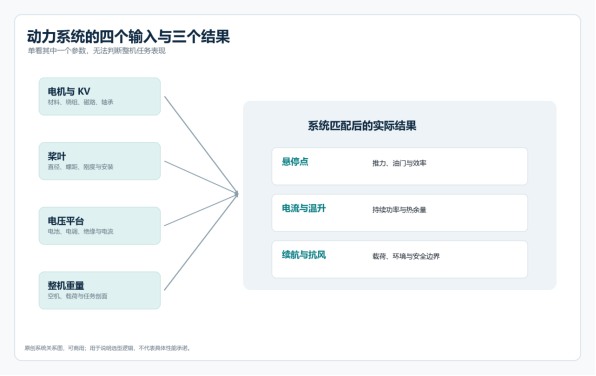
When motor, prop, voltage, take-off weight and environment are coupled, a table of rated numbers struggles to answer what happens in real flight.

Most projects start by comparing peak thrust, KV and motor weight, then pick the strongest-looking datasheet. That is fine for a shortlist, but it hides one fact: peak thrust is a single point measured at full throttle, with a specific prop and voltage, while most mission time is spent hovering, cruising slowly and climbing gently.
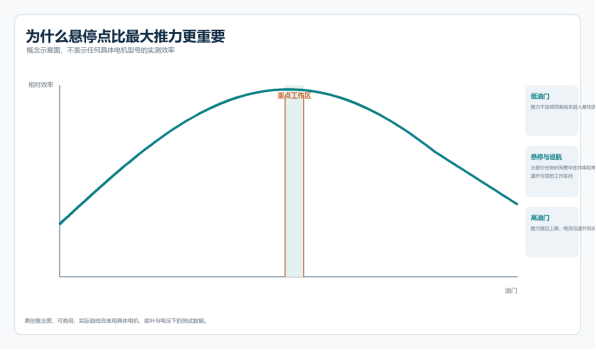
What actually governs endurance and control margin is where the hover point sits on the efficiency curve. If all-up weight, payload or prop change and hovering needs more RPM and current, the motor moves toward its low-efficiency region and heats faster. Peak thrust may still look ample, but the margin left for gusts, climbs or a sagging pack at the end of a flight shrinks.
So evaluate three numbers together: thrust per motor at hover, efficiency at that operating point, and the margin left between hover thrust and peak thrust. Peak thrust answers the ceiling, hover efficiency answers how long a normal mission lasts, and the margin answers whether the aircraft stays controllable when conditions change.
KV, prop, voltage and weight must be read together
KV describes no-load RPM against voltage; it is not a quality grade. Higher KV usually pairs with smaller props, lower KV with larger ones. Change diameter or pitch on the same motor and thrust, current, temperature and noise all move. Discussing KV without prop and voltage turns a matching problem into a false motor problem.
The same applies to voltage. A higher pack lowers current for the same power, cutting line loss and heat, but RPM rises with it. Keeping the same prop operating point usually means re-matching KV and re-checking ESC ratings, capacitors, insulation and battery configuration. “Higher voltage suits heavy lift” does not mean swapping packs alone buys efficiency.
Take-off weight sets the hover point. Added payload does not raise thrust linearly — it pushes the operating point into a steeper part of the curve. Two extra kilograms can cost more than two kilograms of current and shorten endurance. Include motor weight in all-up weight, or you end up with excellent single-motor figures and disappointing aircraft performance.
Noise and wind resistance need stated conditions
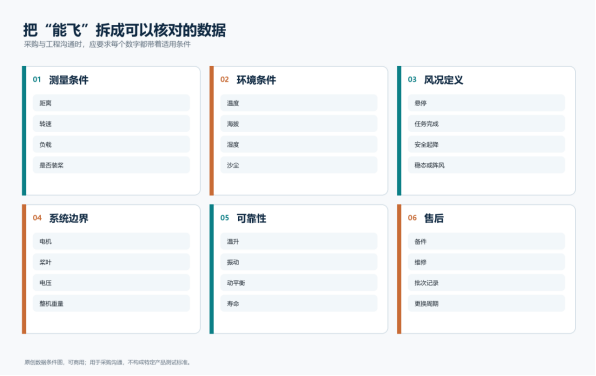
Noise is not a fixed motor property. Prop aerodynamics, stator-rotor electromagnetic forces, bearings and balancing, frame resonance and ESC switching all add up to what you hear. A sound pressure figure without distance, RPM, load, prop state and environment cannot be compared. In engineering discussions, supply the measurement method and the abnormal frequency signature together.
Wind resistance is not one wind-speed number either. Makers may label hover stability, mission completion and safe landing all as a wind rating, yet the three carry different risk. Real capability also depends on payload, altitude, temperature, state of charge and whether the wind is steady or gusting. Multirotors make horizontal force by tilting, and tilt needs thrust margin — so heavy load, thin air or a low pack all compress wind capability.
For buyers, asking about conditions is not extra work — it prevents ideal test values from becoming field promises. In firefighting, inspection, emergency and logistics work the weather is not optional, so test boundaries should be stated more clearly than for ordinary aerial projects, and safe landing should count as a more critical limit than maximum take-off wind speed.
Judge suppliers by the whole data package
A credible power solution treats motor, prop, ESC, voltage, all-up weight and test environment as one system. Motor data alone cannot show whether the prop match is sensible; peak thrust alone cannot show hover efficiency; a single temperature figure cannot show the load and environment behind it.
Ask for thrust, current, efficiency and temperature plotted against throttle, with prop model, voltage, ambient temperature and instrumentation stated. Batch balancing records, bearing and magnet specifications, ESC protocol, fault protection and life testing make consistency easier to judge. Explaining data boundaries clearly says more about engineering capability than a few extra marketing lines.
Projects for hot, dusty or high-altitude markets need environmental validation on top. The same power system can behave differently on a bench and in the field, so thermal management, sealing and service intervals must be verified in real conditions. Closing the loop between test data, operating records and after-sales feedback is how the next selection gets closer to reality.
A workable selection sequence
First, define the mission profile: all-up weight, payload, endurance, hover share, altitude, temperature and wind. Second, calculate hover thrust and safety margin instead of back-calculating aircraft capability from peak thrust. Third, choose KV and voltage platform from prop size and RPM range, then check ESC, wiring and battery.
Fourth, compare efficiency, current and temperature rise at hover and in the usual cruise band, and check control margin at the end of the battery. Fifth, validate noise, wind, dust and maintenance requirements against the target market. Only then discuss appearance, interfaces and price — the selection usually holds up better.
There are no “best parameters” outside an application. The same motor on a different frame, prop or payload shows different endurance, temperature, noise and wind capability. Validating parameters inside the complete system is what turns a catalogue into an engineering delivery.